
Choosing a Privacy-First Wallet: Monero, Haven, and Litecoin under Cake Wallet’s Hood
Imagine you’re moving a meaningful portion of savings into crypto and privacy matters as much as custody. You want Monero for strong fungibility, Litecoin with optional privacy for some retail transactions, and Haven Protocol assets for private stable-value hold. The wallet must keep keys on your phone or hardware device, not on a server, and it must not leak your IP address during sync. Those are reasonable demands — and they point to a few technical choices, trade-offs, and pitfalls that most press pieces skip. This article unpacks how a multi-currency privacy wallet addresses those needs, where the protections are robust, and where operational discipline and architecture limit what it can realistically guarantee.
We’ll use Cake Wallet’s feature set as a concrete, current example to translate mechanisms into decision-useful rules: how Monero’s privacy is preserved in a mobile client, what Litecoin’s MWEB buys and doesn’t buy you, how Haven’s wrapped assets behave, and where network, device, and UX choices change the threat model.
How the wallet keeps keys private — architecture and realistic limits
The strongest single control over custody is non-custodial design: your private keys are generated and stored locally, never transmitted to vendor servers. Cake Wallet follows this architecture and is open-source; that’s essential because it allows inspection of key-handling logic. But open-source is a hygiene factor, not a guarantee — you still need to verify builds or rely on a community you trust.
Device-level security complements architecture. On modern iOS devices the Secure Enclave can encrypt wallet data and isolate keys; on many Android devices a TPM or equivalent provides similar hardware-backed protection. Local authentication — a PIN or biometrics — gates access. These features significantly raise the bar for malware-based exfiltration, but they do not make keys invulnerable. Compromise scenarios still exist: a rooted or jailbroken device, OS-level zero-days, or a compromised hardware wallet firmware can defeat local protection. The practical control you have: keep the device updated, avoid unknown sideloaded apps, and use a hardware wallet (Ledger support and an air-gapped Cupcake option are available) for higher-value custody.
Network anonymity: Tor, I2P, and the remaining fingerprint
A wallet can be non-custodial and still leak metadata through the network. Cake Wallet’s support for Tor-only mode, I2P proxies, and user-selected custom nodes directly addresses the classic IP-leak problem. Use of these transports is a clear improvement over default direct connections, especially in jurisdictions or contexts where your ISP logs access.
But network privacy is compositional: it depends on how the app syncs, whether it fetches remote exchange quotes, and whether it makes auxiliary calls to market makers. Even with Tor, timing correlation attacks and application-layer leaks (e.g., repeated unique wallet behavior during background sync) can reduce anonymity sets. The practical rule: treat Tor/I2P and custom nodes as necessary but not sufficient. If adversaries can observe both network endpoints and timing, additional operational steps — such as changing connection patterns, avoiding parallel apps that reveal identity, and limiting cross-device reuse — matter.
Monero: protocol protections and what a wallet must preserve
Monero’s privacy model rests on ring signatures (hiding senders), stealth addresses (hiding receivers), and confidential transactions (hiding amounts). A wallet’s job is to implement these primitives without leaking view keys or metadata. Cake Wallet preserves the private view key on-device and supports subaddresses, which are practical hygiene: each incoming payment can use a unique subaddress, preventing address reuse and making chain analysis harder.
Common misconception to correct: storing a Monero wallet on a mobile app is inherently unsafe. The truth is conditional. A correctly implemented mobile Monero wallet that never exports the private view key, supports hardware signing, and offers Tor connectivity can be a high-quality option for private, everyday use — but only if the device environment is reliably secure. For high-value holdings, pairing the mobile app with an external hardware signer reduces the attack surface substantially.
Litecoin MWEB: optional privacy and its practical trade-offs
Litecoin’s MimbleWimble Extension Blocks (MWEB) introduce an optional privacy layer that aggregates transactions and obscures amounts. Cake Wallet supports MWEB, allowing users to activate this privacy layer for Litecoin transactions. That optionality is both a feature and a policy decision: optional privacy preserves compatibility with legacy tooling but creates behavioral signals on-chain when users opt into MWEB.
Two trade-offs to weigh. First, optional activation can produce distinguishable on-chain patterns: wallets that routinely use MWEB look different from those that do not, which can reduce plausible deniability. Second, MWEB is still an extension relative to the base chain: some custodial services and exchanges may not support it, creating operational friction when you need to move funds out to broader liquidity. The practical heuristic: use MWEB for transactions where privacy outweighs liquidity friction, and keep a non-MWEB UTXO reserve for transfers to services that don’t accept MWEB outputs.
Haven Protocol (XHV): private “pegged” assets and custodial-like caveats
Haven builds on Monero-style privacy to add tokens that represent pegged assets (private dollars, gold, etc.). A privacy wallet that supports Haven lets you hold these internal asset classes in the same non-custodial framework. Mechanically, Haven’s tokens are separate contract-like records mapped to private Monero-style balances.
Important limitation: pegged assets’ privacy does not eliminate counterparty or economic risk. If you rely on a peg mechanism backed by a specific protocol bridge or market maker, you inherit those counterparties’ availability and policy risk. In short: private tokens can mask on-chain flows, but they don’t magically remove off-chain settlement risk when you need to exit to USD or fiat rails. Keep that in mind when allocating stable-value exposure inside privacy assets.
Built-in swaps, NEAR Intents routing, and privacy implications
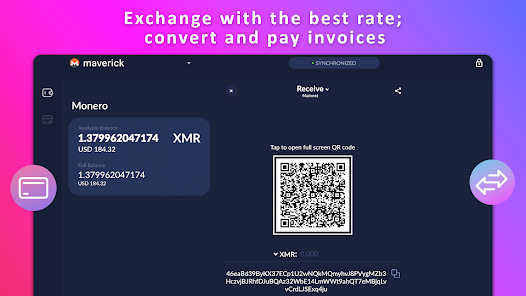
Cake Wallet offers in-app swaps between dozens of assets and uses NEAR Intents for decentralized routing among market makers. That reduces dependence on centralized exchanges and finds competitive rates automatically. From a privacy perspective, decentralized routing is preferable to a single hosted intermediary because it fragments trust and reduces single-point data collection.
However, cross-chain swapping is complex: each swap step may touch multiple counterparties and off-chain liquidity providers. Even with decentralized routing, metadata can leak through quote requests and settlement patterns. If your threat model includes powerful surveillance that can observe multiple counterparties, assume some correlation risk. The mitigation is operational: break high-value swaps into stages, prefer direct on-chain bridges when privacy-aware, and use Tor/I2P during the entire swap flow.
Bitcoin privacy options (Silent Payments, PayJoin, UTXO control)
Unlike Monero, Bitcoin is naturally transparent. Cake Wallet integrates privacy-enhancing techniques: Silent Payments (which obfuscate recipient scripts), PayJoin v2 (which lets sender and receiver collaborate to make a single transaction that conceals linkage), and explicit UTXO coin control and batching. These tools materially raise the cost and complexity of chain analysis when used correctly.
But tools require discipline. Poor UTXO selection, repeated reuse of change addresses, or combining coins from distinct privacy contexts can undo these protections. The wallet gives the controls; the user must apply rules like: never consolidate coins across privacy “silos,” use PayJoin when counterparties support it, and avoid automatic coin selection that mixes contexts.
Operational checklist: what to do and what to avoid
Based on the mechanisms above, here’s a practical checklist for a privacy-minded US user:
- Install from official channels and verify builds when possible (open-source signals but verify).
- Enable Tor-only mode or I2P for synchronization and swaps; set custom nodes if you run a full relay.
- Use device-level encryption and enable biometric/PIN lock; prefer hardware signing for large holdings.
- Use Monero subaddresses routinely; avoid reusing addresses across chains when privacy matters.
- Treat MWEB as optional—activate when privacy is needed, keep a non-MWEB reserve for service compatibility.
- When swapping, prefer decentralized routing via NEAR Intents but assume some metadata leakage across liquidity providers.
If you want to try the client that implements these choices, you can get the official application at cake wallet download.
Myth-busting: three common misconceptions
Myth 1 — “Mobile wallets are inherently insecure.” Correction: Modern mobile hardware with Secure Enclave or TPM, combined with open-source, non-custodial software and hardware wallet integration, can produce a highly secure posture. The caveat: only when the device is not compromised and users follow operational best practices.
Myth 2 — “Using privacy features makes you more suspicious.” Correction: Privacy tools are legitimate safety practices. However, optional privacy features can create identifiable signals (e.g., unique MWEB usage) that reduce plausible deniability. The right approach is context-dependent: for broad merchant use, balance privacy settings to avoid standing out unnecessarily.
Myth 3 — “Non-custodial means risk-free.” Correction: Non-custodial eliminates third-party custody risk but increases user responsibility. Loss of seed phrases, device failure, or mistaken transactions remain leading causes of loss. Use multisig/hardware backups and test recovery flows before transferring large amounts.
What to watch next: technical signals and policy risks
Three conditional trends will affect wallets in the near term. First, adoption of optional privacy layers (MWEB, PayJoin) will increase, but so will pressure from exchanges and regulators who require traceability for compliance; watch service support for those features. Second, decentralized routing and automated NEAR Intents-like systems will become common, improving rates while shifting privacy risks across more counterparties — monitor how routing implementations handle quote privacy. Third, mobile OS supply-chain security will remain decisive: new OS protections or failures (e.g., a widely exploited zero-day) would change the calculus for mobile-only custody.
FAQ
Is Cake Wallet truly non-custodial and privacy-respecting?
Yes: the wallet is open-source and designed so private keys never leave your device. It also enforces a zero telemetry policy and supports Tor/I2P and custom nodes to reduce network leaks. That said, “privacy-respecting” is conditional on your operational choices (network settings, device security, hardware wallet use) and adversary capabilities.
Can I migrate Zcash from older wallets seamlessly?
Not always. There is a known limitation when migrating Zcash from Zashi-style wallets: change address handling differs, so Zashi seed phrases may be incompatible. The safe route is to create a new ZEC wallet and manually transfer funds rather than relying on an automated seed migration.
Does using Litecoin MWEB make my coins unusable with exchanges?
Sometimes. MWEB outputs are not universally supported by exchanges and custodial services. If you plan to send funds to an exchange, keep a non-MWEB UTXO reserve or convert MWEB outputs before withdrawal to avoid failed deposits.
How do in-wallet swaps affect privacy?
In-app swaps using decentralized routing (NEAR Intents) reduce reliance on a single exchange but involve multiple market makers. That fragments trust but can still generate cross-service metadata. For high-stakes privacy, consider breaking swaps into stages, use Tor during the process, and avoid exposing identifying information to counterparties.